Some ancient cities are destroyed by time. Beng Mealea seems to have been reclaimed by nature itself.
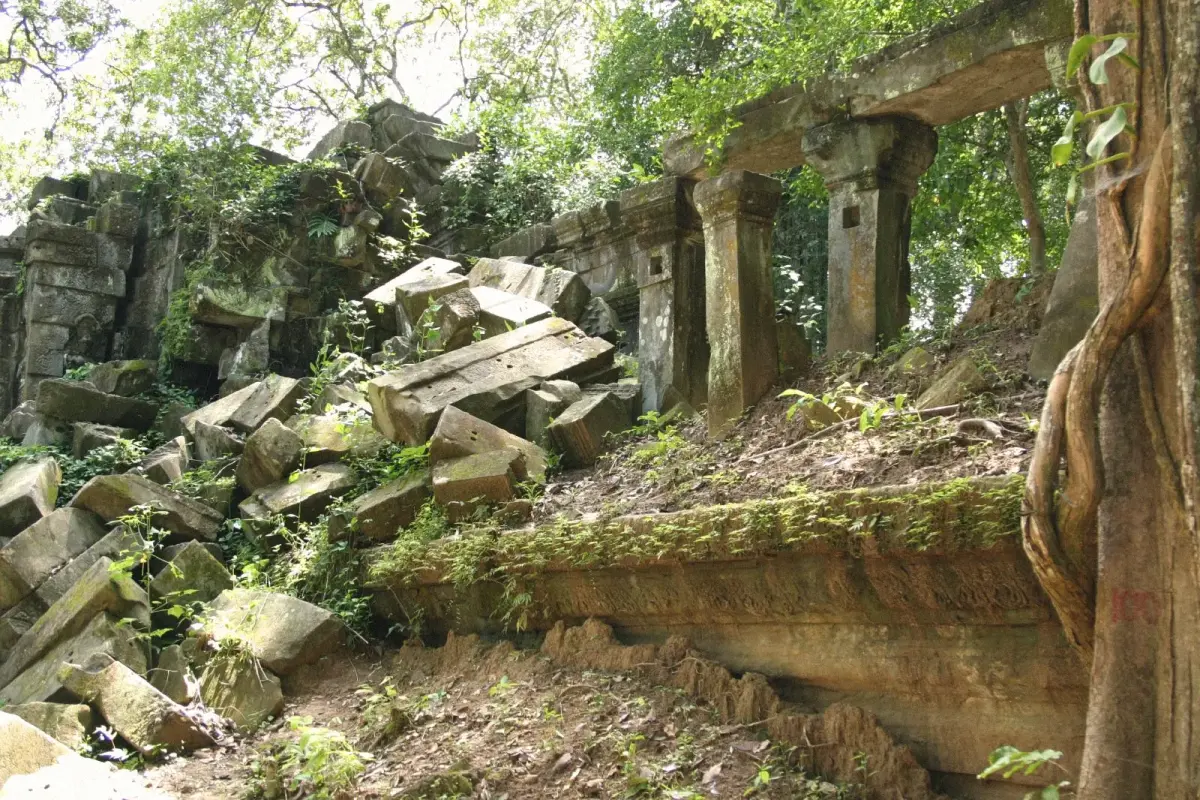
Towering trees have grown through collapsed roofs, massive roots have pushed apart centuries-old walls, and entire galleries lie buried beneath piles of fallen stone. Walking here feels as though you have become one of the first explorers to stumble upon a forgotten city hidden deep within the jungle.
The Jungle Proved Stronger Than the Builders
Many of the temples of the Angkor Empire have been extensively restored over the years. Beng Mealea, however, has been left largely as it was when explorers first encountered it.
Nature is not simply a backdrop here. It has become part of the temple itself. Giant trees continue to support walls that should have collapsed long ago, while their roots have become so tightly intertwined with the stone that it is often impossible to tell where the architecture ends and the forest begins.
That is what makes Beng Mealea feel completely different, even from the famous Ta Prohm.
One of the Largest Temples of the Khmer Empire
At first glance, it may seem like nothing more than a handful of ruined buildings. In reality, the temple complex covers more than one square kilometre.
It was once surrounded by long galleries, courtyards, libraries, towers, and a broad moat. Much of the complex now lies in ruins, yet its sheer scale still reveals the extraordinary ambition behind a monument built nearly nine centuries ago.
There Is No Straight Path Through the Temple
In most temples, the route is obvious from the moment you enter. At Beng Mealea, every turn feels uncertain.
You climb over enormous piles of stone, follow wooden walkways, and weave between partially collapsed walls. Around each corner, another remarkable scene appears: a tree growing from the top of a tower, a roofless corridor stretching into the distance, or giant blocks of sandstone scattered as though they had been tossed aside by a giant.
Because of this, exploring Beng Mealea feels much more like an archaeological expedition than a typical sightseeing visit.
This Is How Angkor Was Once Discovered
When French explorers began documenting the temples of the Khmer Empire in the nineteenth century, many of them looked much like Beng Mealea does today.
Most of Angkor’s famous monuments have since been carefully cleared and restored. Beng Mealea preserves the rare sense of mystery that has disappeared from many other sites. It is one of the few places where you can still imagine what it must have felt like to uncover an ancient city hidden beneath the jungle.
Practical Information
Where It Is
Beng Mealea is located about 65 kilometres east of Angkor and the city of Siem Reap.
How to Get There
The temple can be reached by tuk-tuk, car, motorbike, or as part of an organised tour. The journey from Siem Reap takes about an hour and a half.
How Much Time You Need
Allow at least two hours to explore the complex at a relaxed pace. The site is extensive, and you will probably find yourself stopping often to admire the details and take photographs.
When to Visit
The most comfortable season is from November to February. Early morning is particularly rewarding, when soft light filters through the trees and the temple is still relatively quiet.
What to Bring
Wear comfortable walking shoes, carry plenty of water, and bring insect repellent. Much of the route passes through forest, and some sections require walking across large fallen stones.
Is It Worth Visiting?
Beng Mealea is an unforgettable destination for travellers who want to experience more than another ancient temple. It is a place where nature has slowly reclaimed a masterpiece of the Khmer Empire. While Angkor impresses with its grandeur and restoration, Beng Mealea leaves a different kind of memory—the feeling that history is still unfolding, and that the jungle continues to reshape the temple before your eyes.