Autumn in South Korea is often associated with red and yellow leaves. Yet traveling through the country during this season offers much more than changing colors. The same season can look completely different depending on where the journey takes place. In some regions, attention constantly shifts between forests and rocky peaks. In others, autumn becomes part of a historic landscape. Elsewhere, it unfolds among bamboo groves or on the slopes of the country’s highest mountain.
For this reason, autumn in South Korea is best understood not as a single experience, but as several different versions of the same season.
Seoraksan: Autumn Among the Cliffs
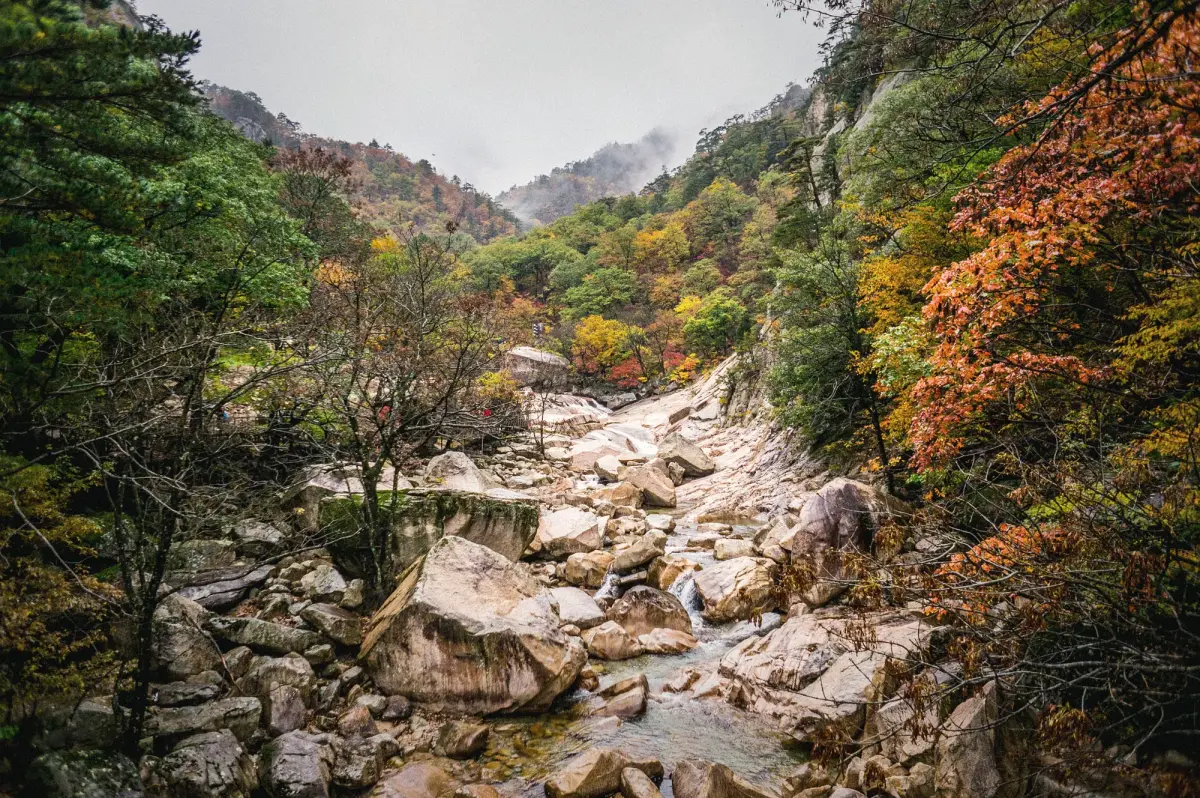
Photographs of Seoraksan often focus on colorful foliage. Once on the trails, attention quickly moves elsewhere. It becomes difficult to separate the forest from the surrounding mountain terrain.
Paths pass between granite cliffs, bridges, valleys, and viewpoints. The forest becomes part of a much larger mountain system rather than the main attraction itself. As the elevation changes, so does the perspective. At one moment, the route faces sheer rock walls. At another, broad valleys open into view before the trail disappears beneath the trees again.
This combination of rugged terrain and autumn forest makes Seoraksan one of the most interesting places in the country during this season. Here, autumn is experienced through movement across a mountain landscape.
Where to find it:
- — Seoraksan National Park — Sokcho area
Hallasan: Autumn on a Volcanic Island
Autumn on Jeju Island looks different from autumn on the mainland. There are fewer mountain ranges, yet the entire island is shaped by volcanic geography.
The trails on Hallasan pass through several ecological zones. As the route climbs higher, the vegetation changes, the views across the island expand, and the distance to the coastline gradually increases. During autumn, these transitions become especially noticeable.
On clear days, the upper sections of the mountain offer views across much of the island at once. In those moments, it becomes easy to see how strongly Hallasan influences the surrounding landscape. Autumn here is experienced less through individual trees and more through elevation, distance, and the scale of the island itself.
Where to find it:
- — Hallasan National Park — Jeju Island
Jirisan: Autumn Across Great Distances
While Seoraksan is often associated with dramatic cliffs and steep terrain, Jirisan is defined by space.
This is one of the largest mountain regions in South Korea. Routes pass through valleys, forests, mountain roads, and remote areas of the national park. Autumn is not concentrated in a single location but unfolds throughout the entire journey.
As the landscape changes, forests, ridgelines, and small settlements appear and disappear along the route. At times, it feels as though the season stretches for dozens of kilometers, accompanying the traveler across an entire region.
Jirisan reveals the scale of autumn in South Korea beyond the country’s most famous destinations.
Where to find it:
- — Jirisan National Park — Jeollanam-do, Jeollabuk-do, and Gyeongsangnam-do Provinces
Damyang: Autumn Among Gardens and Bamboo
After the mountain national parks, Damyang feels entirely different.
Here, attention shifts away from peaks and panoramas toward smaller details. Bamboo groves, gardens, pathways, and ponds create a slower rhythm of travel.
Autumn is especially interesting because of the contrast between colors. The dark green bamboo remains almost unchanged while the surrounding trees gradually turn yellow and red. As a result, the landscape looks noticeably different from that of most mountain parks in the country.
Damyang offers another perspective on Korean autumn — one centered on walking, observation, and the quiet relationship between gardens and the surrounding landscape.
Where to find it:
- — Juknokwon Bamboo Forest — Jeollanam-do Province
Four Different Seasons Within One Autumn
These places are not connected by a single route or by geographical proximity. What connects them is their ability to reveal different sides of the same season.
Seoraksan presents autumn through cliffs and mountain trails. Hallasan shows it on a volcanic island. Jirisan reveals the season through distance and vast landscapes. Damyang offers a quieter version among gardens and bamboo groves.
Together, they demonstrate just how diverse South Korea can be during a few short weeks of autumn.