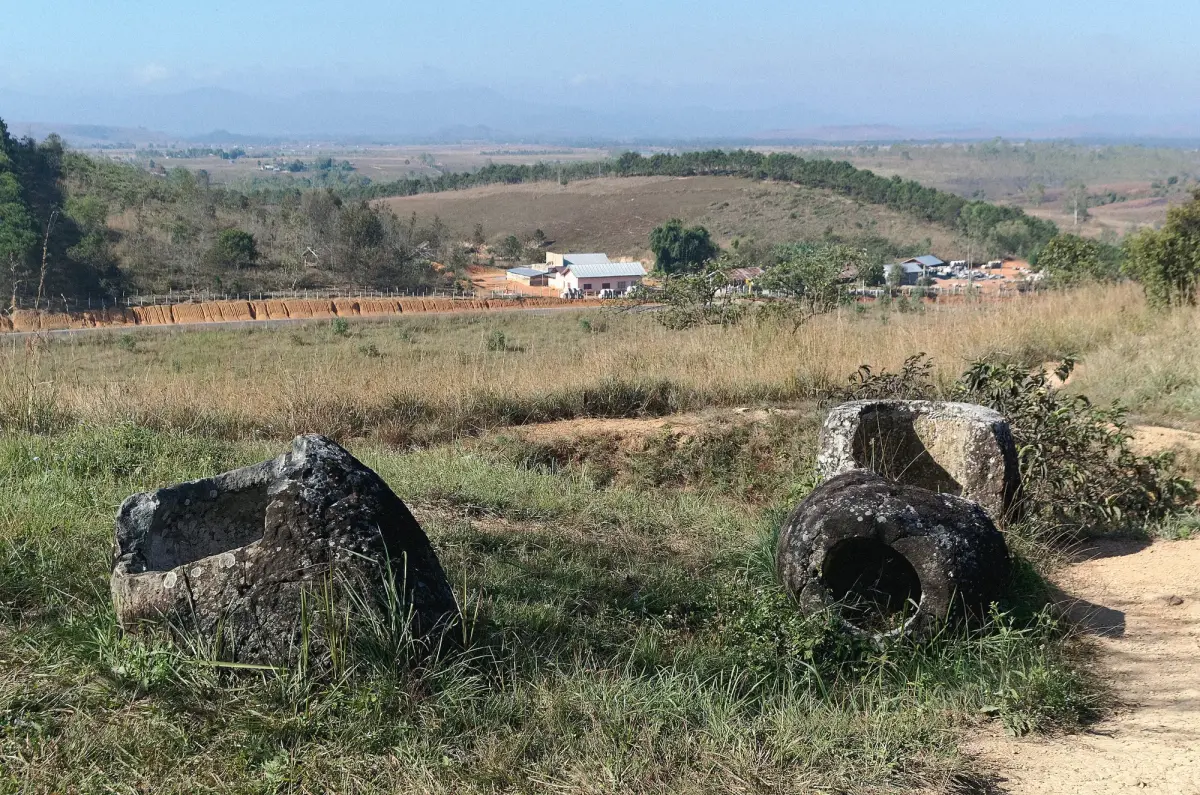
On the hilltops of northern Laos stand hundreds of enormous stone jars. Some rise more than three metres tall and weigh several tonnes. Scattered across open fields, they look as though they were placed there only yesterday, yet archaeologists believe they are more than two thousand years old.
The most remarkable thing is that nobody knows exactly why they were made.
A Mystery That Has Survived for More Than Two Thousand Years
More than ninety archaeological sites have now been identified across the Plain of Jars. Together, they contain around two thousand massive stone vessels carved from single blocks of sandstone, granite, and limestone. Some stand alone, while others are grouped across rolling hills.
Despite decades of research, archaeologists have never reached a definitive conclusion about their purpose. That uncertainty is exactly what makes the Plain of Jars one of the most fascinating archaeological mysteries in Asia.
Many Theories, No Final Answer
Local legends tell of giants who created the jars to celebrate victory after an ancient battle, filling them with rice wine for a grand feast. Although the story belongs to folklore, it reflects how extraordinary this place has always seemed.
Researchers have proposed more practical explanations. The leading theory suggests that the jars were part of ancient burial rituals. Bodies may have been placed inside the stone vessels to decompose naturally before the remains were transferred to permanent graves. Human bones, pottery, and burial objects discovered nearby support this idea, although it has not yet been proven beyond doubt.
Who Could Have Built Them?
Another mystery is just as impressive. Many of the jars weigh several tonnes, while the nearest stone quarries are located kilometres away from where the jars stand today.
No one knows exactly how people over two thousand years ago transported such enormous blocks across rugged hills without modern machinery. The longer you look at these stone vessels, the harder it becomes to imagine the people who carved, moved, and positioned them with the technology available at the time.
Not a Museum, but a Living Archaeological Landscape
The jars themselves are only part of the experience. Their setting is equally unforgettable. These massive stone vessels remain exactly where they have stood for centuries, surrounded by grasslands, scattered trees, and gentle hills.
It feels as though an entire civilisation simply disappeared, leaving behind only these silent monuments. There are no reconstructed buildings or elaborate museum displays. The landscape appears remarkably close to what it might have looked like when the jars were last used.
Traces of a Much More Recent History
The story of the Plain of Jars did not end in ancient times. During the Vietnam War, this region became one of the most heavily bombed areas on Earth. Even today, some surrounding land has not been completely cleared of unexploded ordnance.
For that reason, visitors must remain on marked paths at all times. The contrast between an ancient archaeological mystery and the scars of modern history makes the site even more powerful.
Practical Information
Where It Is
The Plain of Jars is located in Xieng Khouang Province in northeastern Laos. The nearby town of Phonsavan serves as the main base for visitors.
How to Get There
Phonsavan can be reached by domestic flight when services are operating or by long-distance bus from Vientiane or Luang Prabang. The main archaeological sites are only a short drive from town, making a rental motorbike, car, or local guide the easiest way to explore them.
How Much Time You Need
One full day is enough to visit the three principal sites. If you would like to explore lesser-known jar fields and learn more about the region’s history, spending two days is well worthwhile.
When to Visit
The best time to visit is during the dry season, from November to March. Cooler temperatures and clear skies make walking through the archaeological sites much more enjoyable.
What to Bring
Wear comfortable walking shoes and bring water, a hat, and sunscreen. Most importantly, never leave the marked paths, as unexploded ordnance may still exist outside the cleared areas.
Is It Worth Visiting?
The Plain of Jars is an unforgettable destination for travellers who enjoy places where the questions are more intriguing than the answers. You will not find magnificent palaces or towering temples here. Instead, you will encounter one of Asia’s greatest archaeological mysteries, a place where enormous stone vessels continue to challenge everything we think we know about the ancient people who created them.