Most volcanoes are experienced the same way. You begin at the bottom, climb steadily upward, and eventually reach a viewpoint overlooking the landscape.
Quilotoa is the exact opposite.
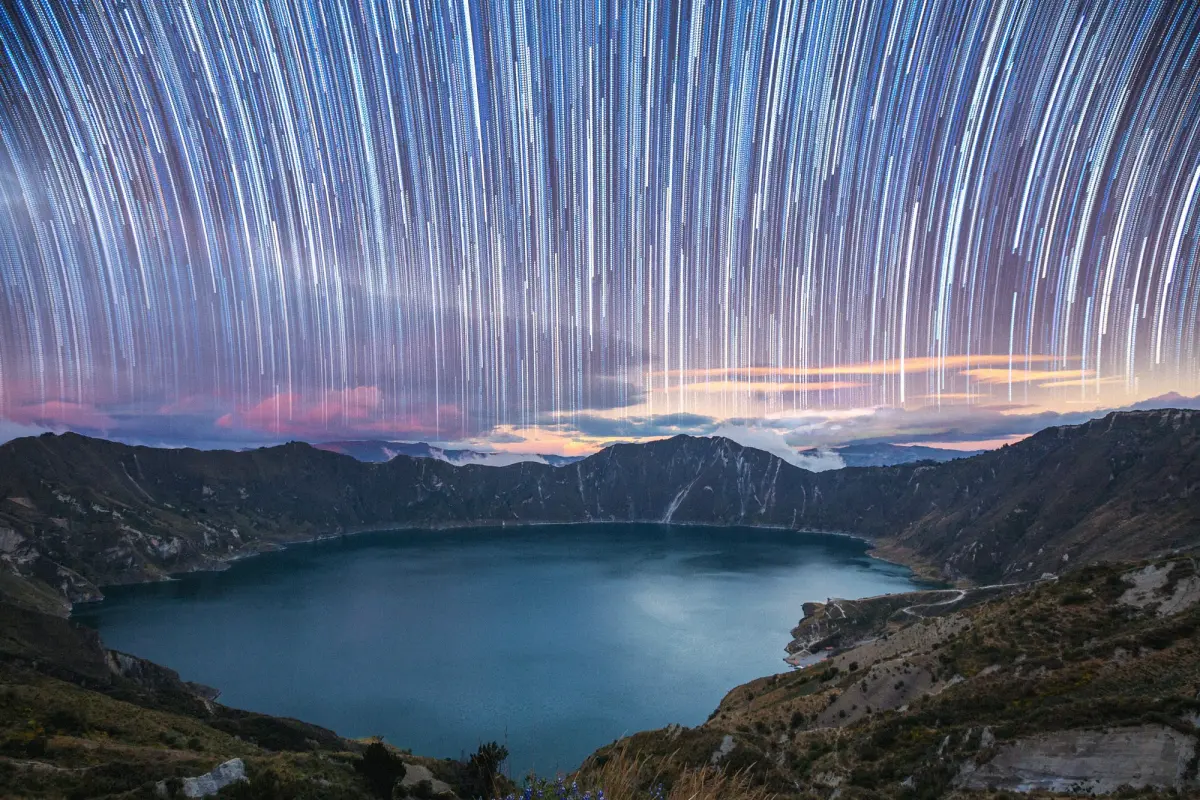
The road takes you almost to the rim of the crater. You walk the last few metres, and suddenly the ground disappears beneath your feet. In front of you lies a vast volcanic basin filled with a striking turquoise lake.
At first, it feels as though you’ve already seen everything. You could take a few photographs and head back to your car.
But the real journey begins where most visitors stop—on the trail leading down into the crater.
A Volcano That Collapsed Into Itself
Quilotoa lies in Ecuador’s Cotopaxi Province, high in the Andes. The lake occupies a giant caldera, a massive depression created when the volcano erupted and its summit collapsed.
The last major eruption took place around 800 years ago. Over the centuries, rainwater and underground springs gradually filled the crater, transforming the site of a violent eruption into one of Ecuador’s most beautiful lakes.
From the rim, it is surprisingly difficult to grasp the true scale of the crater. The opposite wall seems close enough to touch, while the lake appears almost perfectly still.
Only after spending time here do you realise that you are looking at an enormous volcanic amphitheatre nearly three kilometres across.
The rim sits at an altitude of almost 3,900 metres (12,800 feet), so even walking a few steps may remind you that the air is much thinner than at sea level.
A Lake That Never Looks the Same Twice
Photographs almost always show Quilotoa glowing in brilliant turquoise.
Reality is more interesting.
On bright mornings, the lake can appear intensely blue. As clouds move across the crater, it gradually shifts to emerald green, steel grey, or deep jade. Sunlight, minerals suspended in the water, and changing weather constantly alter its appearance.
Sometimes a cloud drifts down into the crater, slowly hiding the opposite wall. Within minutes, the vibrant lake becomes quiet, mysterious, and almost monochrome.
Quilotoa doesn’t always match the image you saw online—and that’s exactly what makes it memorable.
You may end up seeing several completely different lakes during a single visit.
A Trail That Leads Into the Earth
From the main viewpoint, a well-worn trail descends along the inside of the crater toward the lake.
The first section feels surprisingly easy. The path is wide, the lake remains in front of you the entire time, and the shoreline seems to grow closer with every step. Most people reach the bottom in about 30 to 45 minutes.
As you descend, something changes beyond the scenery.
At the rim, you are looking at a landscape.
At the bottom, you become part of it.
The towering walls of the caldera surround you from every direction. The wind fades. The viewing platforms above shrink into tiny dots.
Very few places in the world offer this feeling.
You haven’t climbed a volcano.
You’ve walked inside one.
What You’ll Find at the Bottom
The lakeshore is remarkably simple.
There is no promenade, no cafés, and no long list of attractions waiting below. Instead, you’ll find a small dock, a resting area, and, when conditions allow, kayaks available for rent.
Seen from the shoreline, the crater feels completely different. The perfectly circular shape disappears. Instead, your attention shifts to the immense volcanic walls rising hundreds of metres above you.
Many visitors spend only thirty minutes at the water before beginning the climb back.
That is usually enough.
The purpose of coming down isn’t to find something to do.
It’s simply to experience what it feels like to stand on the floor of a volcano.
The Hard Part Begins on the Way Back
The descent often creates a false sense of confidence.
The climb back quickly changes that.
Although the trail is not technically difficult, the combination of steep slopes, loose volcanic gravel, and high altitude makes the return journey far more demanding than most visitors expect.
The climb typically takes between one and two hours.
You don’t need mountaineering experience.
Patience matters much more than fitness.
Walking slowly and steadily is far easier than trying to rush uphill in thin mountain air.
Local guides also offer rides back up on mules. They can be a practical option, although availability varies, and it’s always worth making sure the animals appear healthy and well cared for before choosing this option.
If you’ve only recently arrived in Ecuador or you’re still adjusting to the altitude, there is absolutely nothing wrong with enjoying the crater from above.
The view from the rim is already spectacular.
Walking the Rim
Descending to the lake and hiking along the crater rim provide two completely different experiences.
The descent reveals the depth of the volcano.
The rim reveals its scale.
The trail follows the edge of the caldera through open alpine landscapes, with constantly changing perspectives over the lake. From some viewpoints, the crater appears perfectly circular. From others, it stretches into an elongated valley enclosed by steep volcanic walls.
At several points, you can see both the lake below and the surrounding Andean mountains beyond the crater.
For first-time visitors, completing the entire rim circuit isn’t essential.
Walking just part of the trail offers many of the best viewpoints while requiring far less time and effort.
Morning Matters More Than the Season
Quilotoa can be visited year-round, but mountain weather changes quickly.
The drier months, generally from June through September, often bring clearer skies and firmer trails. During the wetter season, afternoon rain, fog, and muddy paths become much more common.
Even so, no season guarantees perfect conditions.
The single best strategy is simply arriving early.
Morning usually offers calmer winds, fewer visitors, and the greatest chance of seeing the lake before clouds begin to fill the crater.
If your schedule allows, spending a night in the nearby village is one of the best decisions you can make. It gives you a chance to experience the crater before the day-trip crowds arrive—and to return the following morning if the weather doesn’t cooperate.
More Than a Day Trip
Many travellers visit Quilotoa as a long day trip from Quito.
It’s certainly possible.
However, staying overnight creates a completely different experience.
Simple guesthouses, cold mountain nights, and an early morning walk to the crater often become just as memorable as the lake itself.
Quilotoa is also the final destination of the famous Quilotoa Loop, a multi-day trek linking several traditional Andean villages through canyons, farmland, and highland landscapes.
For hikers, the lake becomes much more than a destination.
It becomes the perfect ending.
Practical Information
How much time do you need?
Around one hour is enough if you only plan to enjoy the viewpoints.
Allow at least three hours if you intend to hike down to the lake and back.
The rim trail requires additional time and should be treated as a separate hike rather than an optional extension.
Getting there
The easiest options are a rental car or an organised day tour from Quito or Latacunga.
Public transport is possible but usually involves multiple connections and takes considerably longer.
Opening hours
The reserve is open daily. Visitor registration is generally available between 8:00 am and 4:00 pm, with visitors expected to leave by around 5:00 pm. As schedules occasionally change, it’s worth checking the latest information before travelling.
Entrance fee
The crater itself is free to visit.
A small community fee helps maintain local facilities such as parking areas and public restrooms.
What to wear
Even on sunny days you’ll want:
- sturdy walking shoes
- a waterproof, windproof jacket
- warm layers
- sunglasses
- a hat
- sunscreen
At nearly 4,000 metres above sea level, the sun feels much stronger than the temperature suggests.
What to bring
Bring water, snacks, cash, and plenty of sun protection.
If you plan to hike along the crater rim, trekking poles and an offline map can also be useful.
Who should take extra care?
Altitude affects everyone differently.
Even experienced hikers may feel short of breath or develop headaches.
If you’ve only recently arrived in Ecuador, consider spending a couple of days at altitude before attempting the descent.
Is Quilotoa Worth Visiting?
If all you’re looking for is a beautiful viewpoint, the rim alone is enough.
The panoramic view from above is spectacular, and the lake’s colours are often most vivid from the edge of the crater.
The descent offers something entirely different.
It changes your sense of scale.
From above, the volcano fits neatly into a single photograph.
At the bottom, it no longer fits within your field of view.
That’s the experience worth travelling for—not simply seeing a volcanic lake, but walking into a landscape that completely surrounds you.