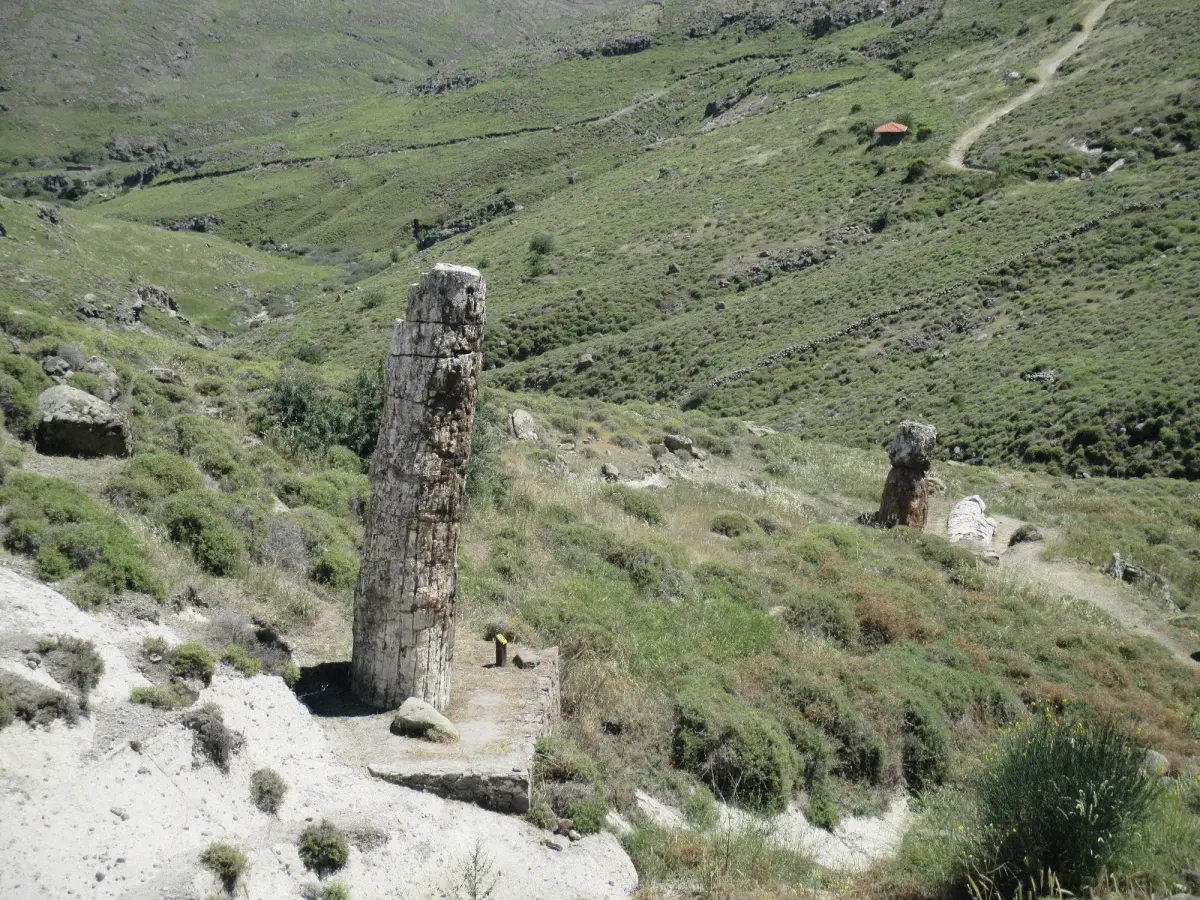
At first, it looks like an ordinary fallen tree.
The trunk lies directly beside the trail. You can see cracks, bark, wood fibres, and even the pattern of growth rings. It seems as though, if you ran your hand across the surface, you would feel the familiar roughness of old wood.
But the tree feels cold.
Because it is no longer a tree.
It is stone.
That is what makes Puyango one of Ecuador’s most unusual places. Here, you can walk through a forest that disappeared tens of millions of years ago, yet somehow preserved its original form.
A Tree That Became Eternal
Most ancient forests disappear without leaving a trace.
Trees rot, turn into soil, and become part of new ecosystems. After several thousand years, it is often impossible to tell where they once stood.
Puyango followed a completely different path.
After the ancient forest died, the trunks were quickly buried beneath layers of sediment. With almost no access to oxygen, the wood stopped decaying in the usual way. Mineral-rich groundwater then began to seep inside.
This process continued for an almost unimaginable length of time.
Gradually, minerals replaced the organic material cell by cell. The original wood disappeared, but its structure remained so precisely preserved that today you can still recognise bark, fibres, and even growth rings.
These are not trees covered in stone.
They are stone that still looks like wood.
A Forest Older Than Human Memory
The fossils at Puyango are tens of millions of years old. Some estimates place them at roughly 100 to 120 million years.
Numbers like these are difficult to imagine.
When these trees were alive, there was no Egypt, no Rome, no agriculture, no cities, and no modern human beings. Even the map of the planet looked completely different.
If the whole of human history were a single page in a book, the forest of Puyango would have appeared thousands of pages before it.
That is why walking here feels so powerful. This is not a reconstruction of an ancient world, and it is not a museum model.
It is a real object that already existed when dinosaurs still walked the Earth.
Trunks Too Large to Move
Museums often display small fragments of petrified wood.
Puyango is different.
Some trunks reach around fifteen metres in length and nearly two metres in diameter. They are so large that they remain where nature preserved them.
Their scale constantly tricks the eye.
From a distance, a trunk may look as though it fell only a few months ago during a storm. Only when you come closer do you realise that it is stone, and that it has been lying here for tens of millions of years.
Photographs rarely capture this sensation properly. The size becomes clear only when a person stands beside one of the trunks.
When the Ancient Forest Lay Beneath the Sea
The most unexpected part of Puyango is not found in the trees.
Among the fossils, researchers have discovered ammonites, ancient molluscs, and other forms of marine life.
At first, this seems impossible.
How could sea creatures appear beside enormous forest trunks?
The answer lies in the geological history of the region. Over millions of years, the landscape changed repeatedly. Coastlines shifted, sections of land rose and sank, and new layers of sediment formed.
As a result, a single walk through Puyango allows you to encounter both an ancient forest and traces of a vanished sea.
A Living Forest Beside a Dead One
Perhaps the most beautiful contrast in Puyango is not created by age alone.
Today, a living forest grows around the petrified trunks. Birds call from the branches, leaves move in the wind, small animals cross the paths, and modern trees rise beside their stone predecessors.
The result is an extraordinary scene.
One forest continues to grow, lose its leaves, and change with every season.
The other completed its story millions of years ago and will never change again.
Two forests exist in the same place, even though an almost unimaginable span of time separates them.
This Is a Place That Rewards Attention
Puyango is not the kind of place that impresses you the moment you step out of a car.
There is no single viewpoint from which everything becomes immediately clear.
The real experience begins when you slow down. You stop beside each large trunk, study its surface, notice the patterns of the wood, and suddenly remember that none of it is wood anymore.
That is why the forest often reveals itself gradually.
For the first ten minutes, it may seem almost ordinary. Then, little by little, the landscape begins to feel completely different.
Practical Information
Where It Is
Puyango Petrified Forest lies in southern Ecuador, between the provinces of El Oro and Loja, close to the border with Peru.
The protected area covers approximately 2,600 hectares.
How to Get There
The easiest way to visit is by rental car or organised tour.
The journey from Machala takes around two hours. From Loja, the route is considerably longer, so many travellers prefer to stay overnight somewhere nearby.
How Much Time You Need
Allow at least two to three hours for the visit.
Those who want to walk slowly, visit the small museum, and carefully examine the largest fossils should reserve half a day.
When to Visit
Puyango can be visited throughout the year.
The drier months are usually more comfortable for walking because the trails are less slippery, and some petrified trunks in stream beds are easier to see. During the rainy season, the surrounding forest becomes much greener, although parts of the route may be wetter.
What to Bring
Comfortable closed shoes, drinking water, a hat, and sunscreen are essential.
Insect repellent is also useful, especially after rain.
Is Puyango Worth the Journey?
Puyango will appeal to travellers who enjoy places that make them think.
There are no dramatic waterfalls, immense viewpoints, or vivid colours that overwhelm you immediately. This forest works more slowly.
Each new trunk changes your sense of time a little more.
For those who want to see a place that existed long before humanity and stand beside a real fragment of the ancient world, Puyango is difficult to compare with anywhere else.
Here, the past is not protected behind museum glass.
It lies directly beneath your feet.