Arriving in the Galápagos Islands means quickly realising something unexpected.
Here, nature does not move aside for people.
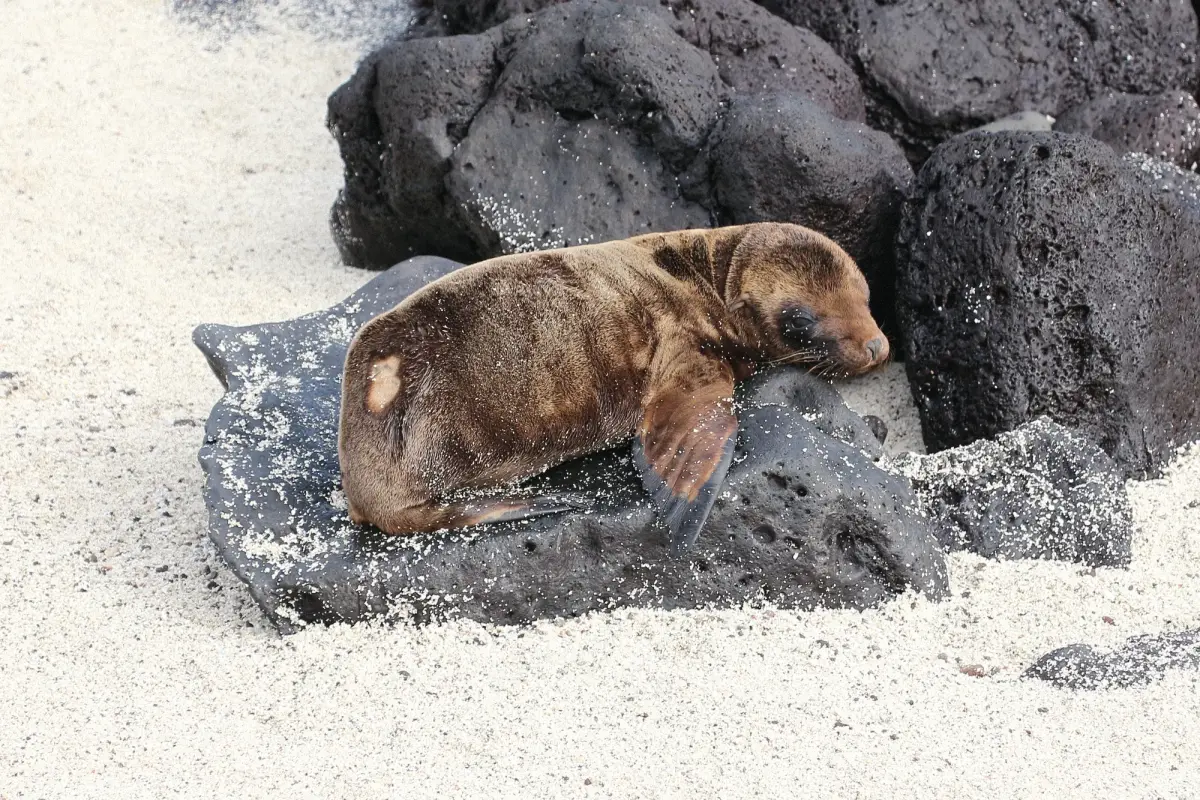
A marine iguana may be lying across the trail. A sea lion may be asleep on a bench near the pier. A blue-footed booby may continue its courtship dance while visitors stand nearby with cameras. None of these animals is trying to entertain anyone, and none appears particularly eager to escape.
In moments like these, the familiar order of the world begins to shift. It no longer feels as though the animals have wandered into human territory. Instead, you begin to understand that you have entered theirs.
Here, Animals Don’t Clear the Path for You
In many national parks, an encounter with a wild animal lasts only a few seconds. You notice movement among the trees, the animal disappears immediately, and you are left wondering whether you really saw it at all.
The Galápagos are different.
An iguana continues resting on sun-warmed volcanic rock. A sea lion lazily opens its eyes before falling asleep again. Birds often continue nesting, feeding, or courting while visitors quietly pass along the marked trails.
This does not mean that the animals are tame. Visitors are not allowed to touch them, feed them, or deliberately approach them too closely. Many species simply evolved on islands where large land predators were almost entirely absent for thousands of years.
They never developed a reason to interpret every large creature as an immediate threat.
That is what creates the unusual feeling found across the archipelago. For perhaps the first time, the human being is no longer the main character in nature.
An Archipelago That Evolved in Isolation
The Galápagos Islands lie almost 1,000 kilometres from the coast of mainland Ecuador. Reaching them by accident has never been easy.
Seeds once arrived on the wind. Ocean currents carried floating vegetation with insects and reptiles aboard. Some birds flew across the sea, while other animals survived improbable journeys over open water.
The few species that reached the islands found themselves almost completely isolated.
Nature then began an experiment of its own.
Some species disappeared. Others gradually changed as they adapted to conditions found nowhere else. That is why the archipelago is now home to animals that cannot be seen anywhere else on Earth.
Observations made here also helped Charles Darwin develop the ideas that would transform humanity’s understanding of evolution.
The World’s Only Marine Lizard
One of the archipelago’s strangest inhabitants looks as though it belongs in a prehistoric film.
The marine iguana is usually dark grey or nearly black. It spends hours lying motionless across solidified lava. When the tide changes, however, this heavy reptile suddenly enters the ocean.
It is the only living lizard in the world that feeds in the sea.
Underwater, marine iguanas scrape algae from rocks. Their long claws help them hold onto the volcanic seabed while currents move around them. After feeding, they must return to the shore.
The reason is simple.
The waters around the Galápagos can be remarkably cold. Until an iguana warms itself in the sun, its muscles cannot function normally. This is why groups of them spend so much time spread across the black lava, using the rocks as natural solar panels.
Visitors may also hear them sneezing loudly. This is how marine iguanas expel the excess salt absorbed while feeding in seawater.
A Dance That Determines the Future of a Family
During the breeding season, visitors may witness one of the most peculiar courtship displays in the bird world.
A male blue-footed booby begins lifting his feet one at a time. He spreads his wings, stretches his neck towards the sky, whistles softly, and carefully displays his bright blue feet.
These movements are not random.
This is his courtship dance.
The intensity of the blue colouring can indicate the bird’s physical condition. The female watches the performance closely while assessing a potential partner.
Yet the strangest part is not the dance itself.
In most places, such behaviour would need to be observed through a powerful telephoto lens. In the Galápagos, the entire ritual may unfold only a few metres from a visitor trail.
Tortoises That Outlive Generations
The giant tortoises gave the archipelago its name.
The old Spanish word galápago referred to a type of saddle. The shells of certain island tortoises reminded early visitors of that distinctive shape.
These animals can live for well over a century. Some individuals survive through several human generations.
Nothing about them appears hurried.
Every movement seems deliberate and almost meditative. After watching a giant tortoise for several minutes, it can feel as though time passes differently around it.
Conservation centres across the islands now breed and protect different tortoise populations. Thanks to these programmes, the numbers of several endangered species have gradually begun to recover.
Why the Wildlife Feels So Abundant
At first, the Galápagos may seem to be overflowing with animals.
The real secret is not simply their number.
It is their visibility.
In many parts of the world, wildlife hides in dense forests, appears mainly at night, or disappears as soon as people arrive. In the Galápagos, much of the natural world continues its daily life in plain sight.
Strict visitor rules help make this possible.
People must remain on marked trails, keep a safe distance, avoid feeding wildlife, and follow the instructions of authorised naturalist guides. Flash photography is restricted in certain situations, and collecting even apparently insignificant natural objects is forbidden.
These rules allow the animals to continue living according to their own rhythms rather than adjusting their behaviour for tourists.
Practical Information
When to Visit
The Galápagos can be visited throughout the year.
From December to May, the ocean is generally warmer and calmer. Underwater visibility can be good, and swimming and snorkelling often feel more comfortable.
From June to November, cooler ocean currents bring nutrient-rich water to the archipelago. The sea can be rougher, but marine activity increases, attracting seabirds, fish, sea lions, and other wildlife.
There is no single perfect season. The right time depends on which animals and experiences matter most to you.
How Much Time You Need
Four days is a reasonable minimum for a first visit.
However, seven to ten days allow travellers to visit several islands and experience a much wider range of animals, volcanic landscapes, and marine environments.
Trying to see the archipelago too quickly can turn a remarkable journey into a sequence of transfers. The distances may look small on a map, but travelling between islands takes time.
Which Islands to Choose
Santa Cruz is a practical choice for a first visit. It has a wide range of accommodation, numerous day tours, giant tortoise reserves, and the Charles Darwin Research Station.
Isabela offers vast volcanic landscapes, large colonies of marine iguanas, and a quieter atmosphere. It is especially rewarding for travellers who want to combine wildlife encounters with hiking and snorkelling.
San Cristóbal is known for its sea lions, accessible beaches, and excellent opportunities to enter the water directly from shore.
Each island reveals a different version of the Galápagos. Moving between them is not merely transportation but an important part of understanding the archipelago.
How to Get There
Flights to the Galápagos depart from Quito and Guayaquil in mainland Ecuador.
There are no direct international flights to the islands.
Before departure, visitors must complete the required entry procedures and obtain a transit control card. A separate national park entrance fee is paid upon arrival.
Travellers should verify the current requirements and fees before booking because regulations may change.
Are the Galápagos Worth the Journey?
Travellers who simply want to see the greatest possible number of large animals in one day may find an African safari more dramatic.
Those primarily interested in whales or dolphins can choose destinations where particular encounters are more predictable.
The Galápagos offer something different.
What stays with you is not the sheer number of animals.
It is the feeling that, for once, humanity is no longer at the centre of everything. The surrounding world continues according to its own rules, and you are briefly allowed to enter it as a quiet observer.