A beautiful city can be spoiled far more quickly than it can be built.
Sometimes a few decades are enough. Bright signs, arbitrary extensions and buildings that pay no attention to their neighbours gradually erode a place’s character. Individual houses may remain beautiful, yet the elusive sense of connection between them begins to disappear.
This is why Czechia’s visual harmony can be as striking as its castles and historic squares. It is not simply that so many old buildings have survived. More remarkably, many towns have preserved the relationships between them. Streets, squares, rooflines, parks and the surrounding landscape can still be read as parts of the same story.
Perhaps this is what gives Czechia such a coherent character.
Preserving More Than a Single Building
In many countries, preservation efforts focus primarily on individual buildings of exceptional value.
In Czechia, the protected object may be much larger. Within historic towns, conservation can extend beyond façades to the street plan itself, public squares, rooflines, views across the town and the character of the surrounding environment.
This may seem like a technical distinction, but it fundamentally changes how a place feels.
Beauty does not come from individual monuments alone. It emerges when the wider space around them continues to function as a coherent whole.
Harmony Does Not Mean Uniformity
At first glance, Czech towns may appear to have been built in a single architectural language.
They were not.
Medieval streets, Renaissance houses, Baroque façades and buildings from later periods often stand side by side. Yet they do not necessarily compete for attention.
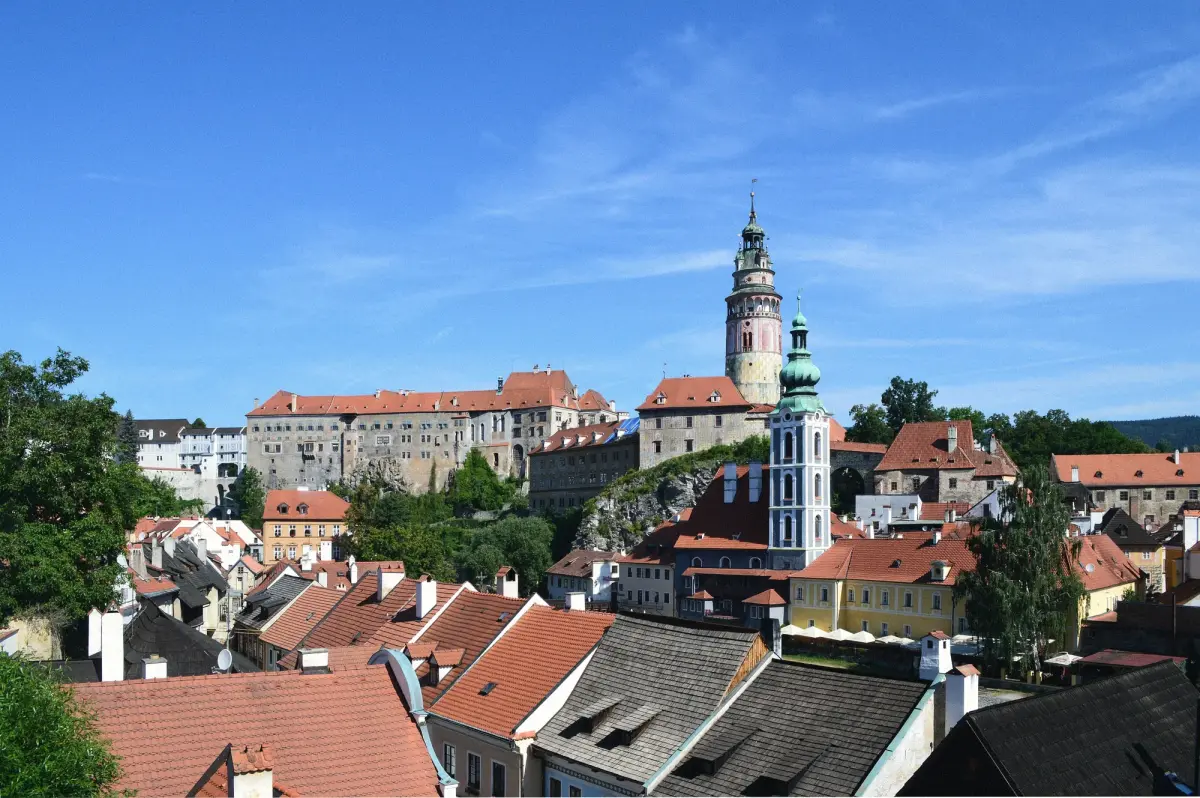
Telč, Český Krumlov and many other historic towns show how different centuries can coexist without destroying the larger composition. Each new layer of history did not entirely erase the one before it, but became part of its continuation.
This may be one reason Czech towns can feel so calm. One era rarely seems to be trying to shout over another.
The River, the Hill and the Town Often Tell the Same Story
In some of Czechia’s most remarkable towns, nature is not merely a backdrop.
It forms part of the composition.
In Český Krumlov, a bend in the Vltava shapes the old town. In Mikulov, the château, surrounding hills and vineyards form a single landscape. Across the Lednice–Valtice Cultural Landscape, palaces, parks, avenues and fields were conceived as parts of one extensive environment.
This is why many views seem so natural.
The town appears to stand where it does not by accident, but because it is difficult to imagine it belonging anywhere else.
Harmony Has a Less Picturesque History
It can be tempting to imagine that Czech towns simply survived intact by some extraordinary stroke of luck.
The reality is more complicated.
Preservation was not always consistent. The twentieth century brought wars, political upheaval and long periods in which many historic buildings received insufficient care. After 1989, extensive restoration was required to repair and recover much of the historic environment.
The harmony visible today is therefore not simply a gift from the past.
It is the result of sustained work by architects, conservation specialists, municipalities, property owners and the many people who gradually helped restore the character of these places.
Harmony Is Maintained Every Day
This may be the part that explains Czechia most clearly.
A beautiful town cannot be preserved once and for all.
Historic buildings require continual maintenance. Work within protected areas is reviewed by heritage specialists. Public programmes support the restoration of monuments, while many old buildings remain in active use: they contain shops, cafés, libraries and museums, and continue to serve as homes.
This may be why Czech historic centres so rarely feel like museum sets.
They remain part of everyday life.
Perhaps this is what travellers most often recognise as harmony.
It does not arise from identical façades or from an attempt to make everything perfect.
It appears where the past is allowed to remain part of the present.
If You Would Like to See Czechia This Way
Do not judge a town by its main square alone. Walk several streets farther and notice how the houses, gardens, streets and views remain connected beyond the most obvious landmark.
Climb to a viewpoint. Czech towns are often easier to understand from above. From there, the relationship between rivers, hills, castles and historic districts becomes much clearer.
Look not only at the buildings, but at the space between them. The width of a street, the line of the roofs, mature trees or a carefully framed view may shape your impression as strongly as any individual façade.
Visit a smaller town. Telč, Litomyšl, Mikulov, Loket and many other places show that this sense of harmony extends far beyond Prague.
Return to the same town at different times of day. Morning light, daytime activity and evening quiet each reveal the same space differently. This is often when it becomes clear why these towns invite visitors not merely to photograph them, but to spend time within them.