Some towns are remembered for individual landmarks. A beautiful church, an impressive castle, a picturesque street. Days later, those separate images come together to form the memory of a journey.
Telč leaves a different impression. It is surprisingly difficult to choose a single highlight because what stays with you most is not one building but a remarkable sense of harmony. It feels as though the entire town was conceived as one architectural composition, with every house knowing exactly where it belongs.
That is one of the reasons why the historic centre of Telč was inscribed on the UNESCO World Heritage List in 1992.
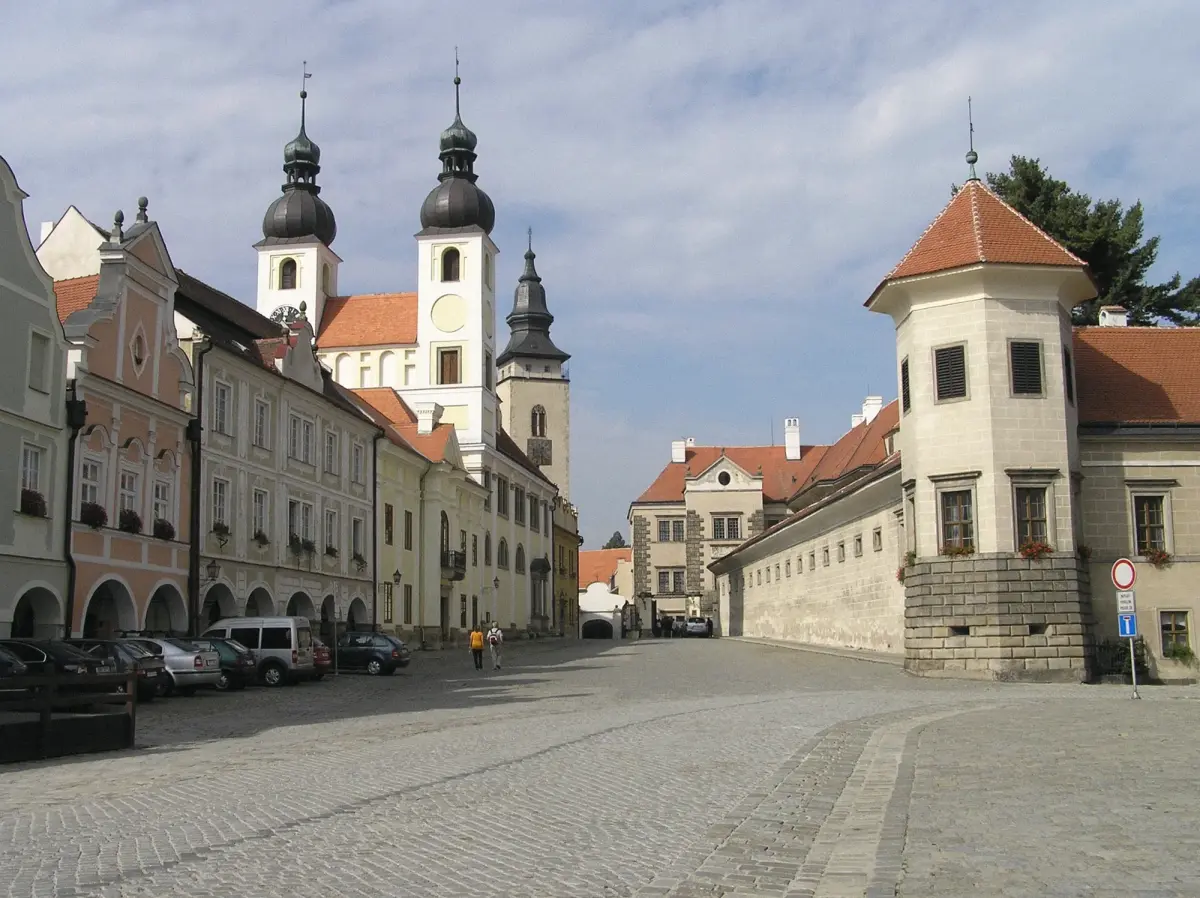
A Square Where No Two Houses Are Alike
At first glance, Telč is easy to remember for its pastel façades. Stay a little longer, however, and you begin to realise that colour is only the most obvious part of the story.
Almost every house around the square is different. Their gables, windows, decorative plasterwork, sgraffito patterns and proportions all vary. Some façades retain their Renaissance character, while others were later reshaped in the Baroque style. Yet the square never feels visually crowded.
That is what makes it so unusual. The buildings do not compete with one another—they seem to participate in the same quiet conversation. The continuous arcades along the ground floor tie the façades into a single rhythm, the consistent scale prevents any one building from dominating the scene, and the elongated shape of the square encourages you to experience it as one complete space rather than a collection of individual houses.
Why It Feels as Though the Town Was Built All at Once
That impression is deceptive.
Telč evolved over several centuries. After a devastating fire in the late fourteenth century, its wooden buildings were gradually replaced with stone ones. During the sixteenth century, under Zachariáš of Hradec, the medieval town began its transformation into a Renaissance ensemble, and later generations added Baroque façades to many of its houses.
Yet as you walk through the square, it is remarkably easy to believe that everything was created as part of a single vision. The secret is not uniformity. Quite the opposite: every building has its own character. What creates the sense of unity is the medieval street plan, the uninterrupted arcades, the consistent scale of the buildings, and the way each new generation respected the framework it inherited.
The Castle Doesn’t End the Town—It Continues It
In many European towns, the castle feels like a separate destination. You make a deliberate journey to reach it and then return to the town afterwards.
Telč works differently. The square gradually leads you towards the castle, and before you notice it, your walk simply continues through its courtyards.
The Renaissance arcades, quiet inner spaces, sgraffito decoration and carefully balanced proportions all speak the same architectural language as the square itself. Instead of standing apart from everyday life, the castle feels like its natural continuation.
Here, Water Doesn’t Decorate the Town—It Explains It
Today, the ponds surrounding Telč appear to be part of its picturesque scenery. They mirror the rooftops, towers and castle walls, and walking along their banks is one of the most peaceful experiences the town offers.
Originally, however, they were not created for beauty. They formed part of the town’s defensive system, strengthening its fortifications.
That is why it is worth leaving the square for a while. Seen from across the water, Telč reveals itself as something much greater than a beautiful collection of streets. It becomes clear that the town was planned together with its surrounding landscape, where architecture and water belong to the same composition.
Why It Feels So Peaceful to Walk Here
Telč never tries to impress through sheer scale. It has no tallest cathedral, no grand boulevard, no overwhelming palace competing for attention.
Instead, everything remains comfortably human in scale. The square is spacious without feeling overwhelming. The arcades create a sense of shelter, the streets are easy to understand, and your eye rarely encounters visual clutter.
Perhaps that is why walking through Telč feels so calming. There is no urge to rush towards the next landmark. The walk itself becomes the experience.
What to Look For
Rather than searching for the most beautiful façade, try noticing the details that are easy to overlook.
Look at how differently each gable has been designed. Walk along one side of the square beneath the arcades, then return across the open space and notice how your perception of the same buildings changes. Step inside the castle courtyards before making your way to the ponds, where the entire silhouette of the town comes into view.
Gradually, you begin to realise that Telč owes its beauty not to individual buildings but to the relationships between them.
How Telč Has Preserved Its Character
The historic centre of Telč has witnessed changing fashions, different owners and centuries of architectural evolution. Yet it escaped the large-scale redevelopment that transformed so many European towns during the nineteenth and twentieth centuries.
Today, protection extends far beyond individual monuments. It includes the medieval street plan, the town’s skyline, its rooflines, and the relationship between the square, the castle and the surrounding ponds. It is this remarkable integrity—not a single outstanding building—that earned Telč its place on the UNESCO World Heritage List.
If You Want to Experience Telč This Way
Don’t settle for a single photograph from the middle of the square. Walk its entire length beneath the arcades, then return along the open side and notice how the space changes. Make time to stroll around the ponds as well—the view from across the water reveals how closely the town is connected to its landscape.
When visiting the castle, don’t focus only on its interiors. Its courtyards help explain why the castle feels like an extension of the town rather than a separate attraction. And instead of searching for the most beautiful house, try seeing how dozens of very different façades come together to create one harmonious composition.
A Town Where Beauty Is Born from Harmony
Telč is often described as one of the most beautiful small towns in the Czech Republic. Yet its beauty cannot be explained simply by colourful façades, an elegant castle or reflections on the water.
What truly makes Telč remarkable is the relationship between its parts. The arcades connect the houses, the square flows naturally into the castle, the ponds complete the town’s historic layout, and buildings from different centuries remain united within the same medieval framework.
Perhaps that is why, long after your visit, you are unlikely to remember a single façade above all the others. What stays with you is Telč itself—a rare town where centuries of history have come together to create one remarkably harmonious whole.