When people talk about the highest mountain on Earth, Mount Everest is almost always the first name that comes up. Its summit is indeed the highest above sea level. But if you ask a different question—which point on Earth’s surface is farthest from the planet’s center—the answer is surprisingly different. It is Chimborazo, an extinct volcano in Ecuador.
Why Everest Loses This Comparison
We often imagine Earth as a perfect sphere. In reality, it is slightly flattened at the poles and wider around the equator because of its rotation. This equatorial bulge changes the way we measure distance from the planet’s center.
Chimborazo stands almost exactly on the equator, meaning its summit starts from the widest part of the Earth. Although Everest rises nearly 2,500 metres higher above sea level, Chimborazo’s summit is about two kilometres farther from the Earth’s center. By that measurement, it is the closest point on Earth’s surface to outer space.
A Different Way to Think About Height
This unusual fact completely changes the way most people think about mountains. Height depends not only on how far a peak rises above sea level, but also on the shape of the planet beneath it. Ask the same question in a different way, and the winner changes.
That is why Chimborazo is often called the mountain that challenges expectations. It does not hold the record for elevation above sea level, yet it claims a far more surprising distinction.
You Climb Higher—and Farther
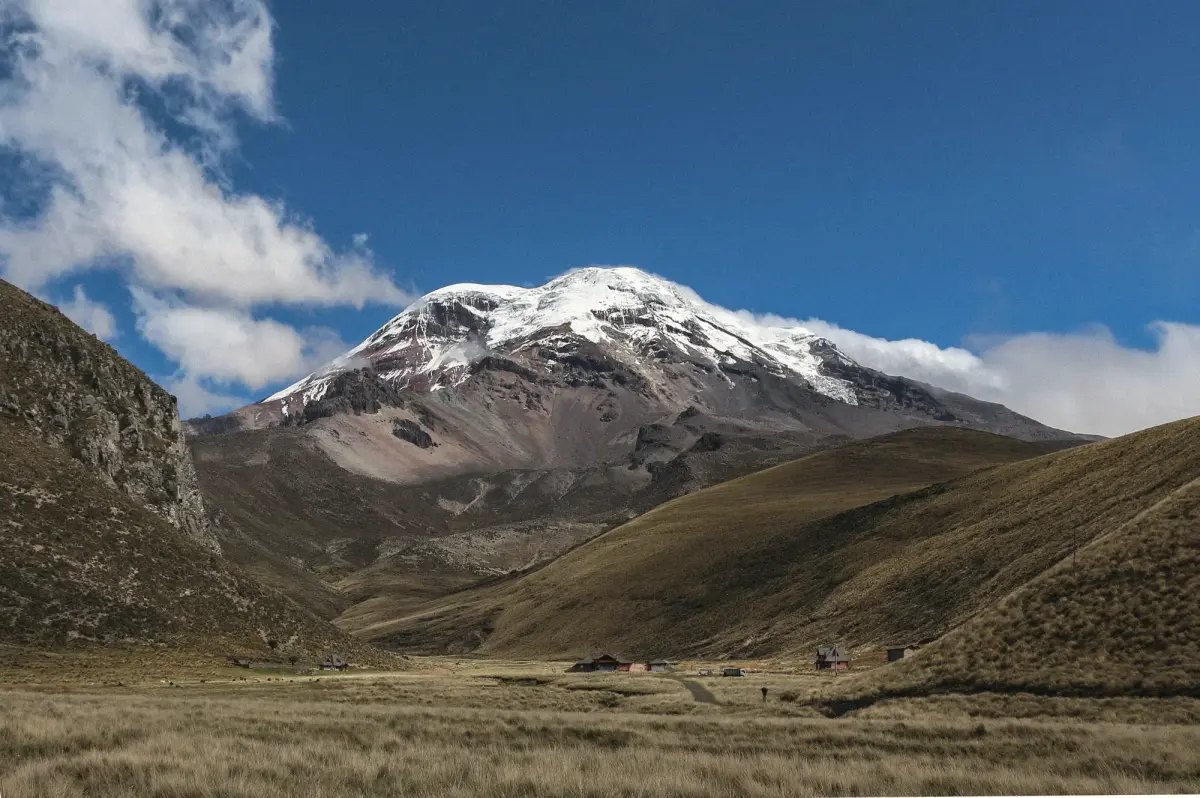
Even if you never attempt the summit, visiting Chimborazo is an unforgettable experience. The road climbs through the high-altitude páramo, where hardy grasses sway in the wind, wild vicuñas graze across the plains, and the air grows noticeably thinner with every kilometre. The landscape becomes so stark that it feels almost untouched by ordinary life.
As you continue climbing, the altitude quickly makes itself known. Even near the mountain refuges, many visitors notice that walking becomes slower and breathing requires more effort. It is one of the few places where you can physically feel how thin the atmosphere becomes as you approach the sky.
A Volcano That Still Shapes the Landscape
Chimborazo is an extinct volcano that helped shape the surrounding valleys and highland plateaus. For centuries, its glaciers supplied water to nearby communities, and they remain among Ecuador’s largest surviving glaciers today. Despite its location near the equator, the summit is covered with snow and ice for most of the year.
On a clear day, the volcano dominates the horizon from many kilometres away. Its solitary white summit rises above the surrounding plains with remarkable elegance. It is difficult to imagine how many geological processes were required to create such a landscape.
More Than a Geographic Record
Many people come simply because they want to stand on the point closest to space. Yet most leave remembering something entirely different. They remember the endless páramo, the herds of vicuñas, the glaciers, the brilliant equatorial sunlight, and the extraordinary feeling of standing at extreme altitude.
That is what makes Chimborazo so memorable. A fascinating scientific fact becomes the starting point for a journey that lets you experience the shape of our planet in a way that few places on Earth can.
Practical Information
Where It Is
Chimborazo is located in central Ecuador, about 30 kilometres from the city of Riobamba. The mountain lies within the Chimborazo Wildlife Production Reserve, a protected area created to preserve the region’s unique high-altitude ecosystem.
How to Get There
Most visitors reach Chimborazo by car or as part of an organised tour from Riobamba. A paved road leads directly to the first mountain refuge, making it possible to experience the volcano without undertaking a demanding hike.
How Much Time You Need
If your goal is to visit the viewpoints and the first refuge, half a day is usually enough. Allow a few extra hours if you plan to walk between the refuges or explore the surrounding trails. A full summit ascent requires technical preparation and is normally completed over two days.
How Difficult Is the Walk?
Most visitor routes are suitable for people with average fitness. The main challenge is not the terrain but the altitude, which exceeds 4,800 metres above sea level near the upper refuge. Even a short walk can feel surprisingly demanding because of the thin air.
When to Visit
Chimborazo can be visited throughout the year. The driest months generally offer the most stable weather, although conditions in the high mountains can change very quickly. It is always worth checking the forecast before setting out.
What to Bring
Temperatures remain low even under bright sunshine, and strong winds are common. Warm layered clothing, a windproof jacket, sunglasses, high-SPF sunscreen, and plenty of drinking water are all essential. At this altitude, the sun is much stronger than many visitors expect.
Is It Worth Visiting?
Chimborazo is an ideal destination for travellers who enjoy unusual geographical facts and spectacular mountain scenery. If you are looking for a place that changes the way you think about the world’s great natural landmarks, few mountains are more fascinating. Add wild vicuñas, ancient glaciers, and the feeling of standing closer to space than anywhere else on Earth, and the experience becomes unforgettable.