Imagine walking down a staircase and finding yourself inside a vast brick cathedral. Massive columns stretch into the distance, soaring vaulted ceilings rise overhead, and the dim light blurs the edges of the space.
No organ has ever echoed here. There has never been an altar, a priest, or a congregation. Because this is not a church at all, but one of the most remarkable feats of engineering in the Czech Republic.
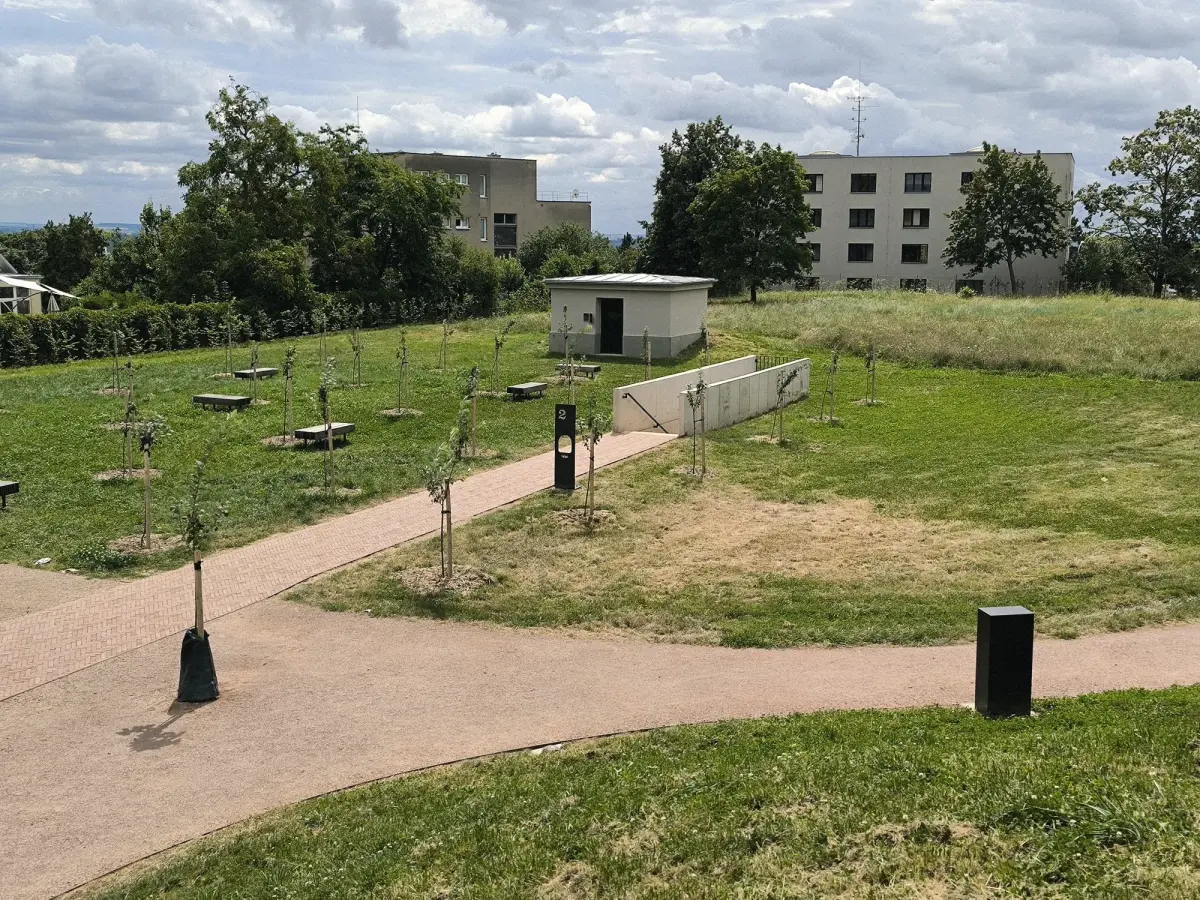
Hidden beneath an ordinary park on Brno’s Žlutý kopec (“Yellow Hill”) are three enormous underground reservoirs built in the nineteenth and twentieth centuries to store the city’s drinking water. Their purpose is entirely practical, yet the atmosphere they create feels almost sacred.
Why Your Brain Sees a Cathedral
The most surprising thing happens before you even learn the story behind this place. Your brain has already decided that you are standing inside a church.
There is a simple reason for this. We associate soaring vaults, rows of columns, long perspectives, and perfect symmetry with religious architecture. Without realizing it, our minds classify the space as sacred, even though there is not a single religious symbol in sight.
It takes a few moments to accept the truth. This entire structure was never built for people.
Nobody Set Out to Create Beauty
When engineers designed these reservoirs, beauty was never part of the brief. Their only objective was to create a structure capable of supporting the immense weight of thousands of tons of water for decades.
Every column exists to support the vaulted ceilings. Every vault distributes the load efficiently. Every proportion follows the laws of engineering rather than artistic taste.
That is where the real paradox lies. The more honestly the engineers solved their technical problem, the more beautiful the finished structure became.
An Entire Hidden World Beneath an Ordinary Park
Walk through Žlutý kopec today, and you would never guess what lies beneath your feet. People stroll along the paths, relax on benches, and enjoy the park without realizing that thousands of square meters of brick galleries stretch out below them.
That contrast is part of what makes this place so extraordinary. One of the Czech Republic’s most breathtaking interiors remained hidden from public view for generations.
Only recently have the reservoirs been opened to visitors. Before that, they quietly performed the task they had been built for—supplying Brno with clean drinking water.
Why the Photographs Look Unreal
Many people mistake photographs of these reservoirs for images of an ancient monastery, a medieval crypt, or even a computer-generated fantasy. Endless rows of columns create the illusion of infinite space, while the soft light dissolves into the brick vaults, making the underground chambers seem almost limitless.
When a thin layer of water covers the floor, the effect becomes even more dramatic. The reflections double the columns, transforming the reservoirs into a perfectly symmetrical underground labyrinth.
It is no surprise that photographers are drawn here. The architecture itself seems to compose every shot.
Why People Begin Speaking More Quietly
Almost everyone lowers their voice within a few minutes of entering. No signs ask visitors to remain silent, yet the space seems to encourage it naturally.
Perhaps the architecture is responsible once again. The towering vaults, the rhythm of the columns, and the subdued lighting create many of the same emotions people experience inside historic cathedrals.
The only difference is that this place was never intended for worship.
Why You Will Remember It
Most iconic buildings were designed to inspire admiration. Architects carefully considered proportions, decorative details, and visual impact to create something beautiful.
Brno’s underground reservoirs were built for an entirely different purpose. They were simply meant to store water and perform their job as reliably as possible.
Perhaps that is exactly why they leave such a lasting impression. Sometimes the most extraordinary architecture is born not from the pursuit of beauty, but from the pursuit of the perfect engineering solution.